THE NOOMA WAITLIST IS NOW OPEN. Founding Members lock in 25% off. Permanently.


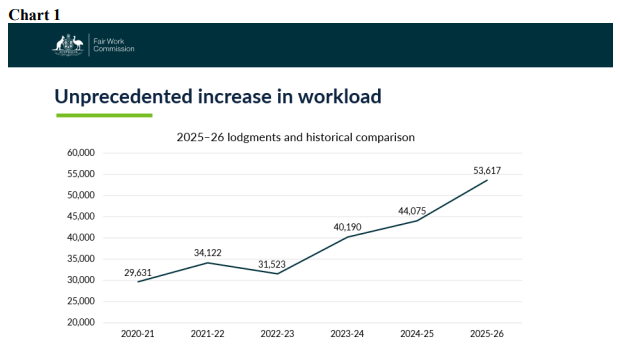
In the world's least shocking news to anyone who's managed people this year, Fair Work claims are up again. When I wrote about why employee relations cases are increasing, general protections dismissal applications were running around 45% higher year on year. The Fair Work Commission has now received a record 53,617 lodgements in 2025–26, up 22% on the year before and 81% on 2020–21. Speaking at an industry conference in September, the Commission's President, Justice Adam Hatcher, said the "very significant increase" in applications is "obviously a challenge for employers, who are having to respond to a much greater number of applications".
I began tracking this in a line graph to show the sharp trend last year, and this year, they've released it for us.
If lodgements had followed the trend of the previous four years, 2025–26 would have landed somewhere between 46,000 and 48,000. The actual figure came in more than 5,000 above that, and the extra 9,542 lodgements were the biggest single-year jump on the chart. The steepest rise in percentage terms came earlier, in 2023–24, the first full financial year after generative AI tools became widely available. As Justice Hatcher put it, Chart 1 shows "the growth accelerated in FY 2025-26".
"In retrospect, the key event in the timeline of Chart 1 is that, in November 2022, the first publicly available version of ChatGPT was launched", said Justice Hatcher. His second observation was that there was "no sign yet that this growth is plateauing or even slowing down".
The Commission's research found around 40% of surveyed applicants used generative AI to prepare their case, and Justice Hatcher has said the real figure "may well be higher". The research found that AI lowers the barrier to bringing a claim and is steering some people who can't bring an unfair dismissal claim towards the general protections jurisdiction instead. That lower barrier helps people with genuine claims who would otherwise struggle to put their case together. It also makes it easier to lodge a claim that's underdeveloped or built on a misunderstanding of the law.
"Apart from the sheer number of additional applications, self-represented litigants impose a disproportionately greater workload to the commission and upon employer respondents dealing with them, because they lack objective advice to guide their conduct in litigation, tend to be more insistent on their subjective perception of their position and thus less amenable to settlement, and it is often difficult to understand what the case is they are trying to present", the President said.
We have tested this ourselves. O-HR's own Responsible AI Analyst conducted testing of how the major AI tools handle Australian award questions. When a question deliberately named the wrong award, some tools went along with it, still producing a confident, complete-looking pay rate. Someone without objective advice has no way to spot that, so a tool that confirms their framing can harden their view of the case when it should be testing it. We’ll publish the full findings in a separate report. Two related observations here. Firstly, generative AI uses predictive, not deterministic, statistical models, so errors are built into how they work and can't be engineered out completely. Secondly, big tech, adding sycophancy into GenAI and their social media algorithms, fuelling confirmation bias, has a lot to answer for outside of this context.
In a recent mic-drop moment in the case of Khan v Aldi Pty Ltd, the Deputy President's message was: don't waste our time. Mr Khan was told he was dismissed three days before he would have completed the six-month minimum employment period, so he couldn't bring an unfair dismissal claim. (For small business employers with fewer than 15 employees, the period is 12 months.) The Commission warned him more than once.
Deputy President Easton found the arguments were "just plain wrong", that "ALDI had no choice but to defend the claim", and that "Mr Khan could have and should have chosen to cut his losses when he had the chance". Mr Khan was ordered to pay $1,230 towards Aldi's costs, though the Deputy President acknowledged Aldi had spent "significantly more than $1230 in legal fees defending an application that should have never been made". The Deputy President called it a "very rare step" in a jurisdiction where parties ordinarily pay their own costs. Mr Khan has since lodged an appeal against the decision under s 604 of the Act, so watch this space.
Aldi still had to respond to the claim, prepare for a hearing and turn up to it. The costs order covered only a fraction of that effort, and none of the internal time.
Here is the breakdown of what employees are taking their employers to the Commission for:
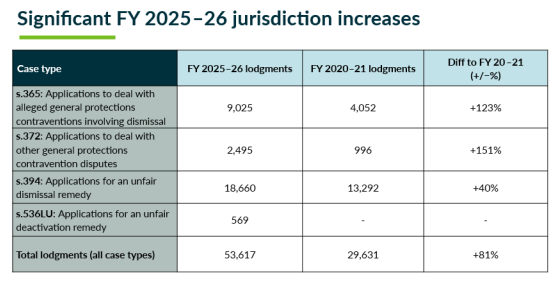
A few key things to point out, here. In layman's terms, a s 365 application is where an employee claims they were dismissed for a prohibited reason, or for reasons that include one. That might be exercising a workplace right, such as making a complaint about their employment, or a protected attribute such as disability, sex, sexual orientation, pregnancy, or family or carer's responsibilities. A s 372 application covers the same protections where the employee wasn't dismissed but claims other adverse action. This could be a demotion, reduction of hours (even systematic casuals), requirement to work in the office, reallocation to a new job, not giving them a promotion, etc.
There's also no minimum employment period and no small business exemption to fall back on.
The issue is that this type of matter has a reverse onus of proof. What does that mean? The law presumes you acted for the reason the employee alleges, and it's up to you as the employer to prove you didn't.
So even if you had a valid reason, you'll struggle to rebut that presumption without records made at the time that show what your reasons actually were.
Every claim, strong or weak, has to be answered. That means a response form, which now includes the AI disclosure and checking declaration, as well as conciliation, often a hearing, and evidence.
The Commission is also taking longer to get through its caseload. An aged caseload is a drain on HR teams' time, resources and impact. The median age of open cases, measured from when the application was filed, has "increased from 28 to 39 days".
I have been brought in to businesses before to help with this exact problem. A big employer in a highly regulated industry, facing a 60% uplift in cases year-on-year, a growing backlog and an average days-to-resolve of 45.
The real damage was to HR's standing: business leaders couldn't get responsive, trusted support from business partners who were drowning in a highly complex caseload. The real damage wasn't settlement fees, but the HR brand equity. With focus and four months, we kept up with the incoming caseload and resolved 61% of the aged cases, with the remainder being referred to legal. Importantly, we also put some value back into the equity of the HR brand across the business.
In other news that came out just this week, the interim report of the Productivity Commission into business dynamism, acknowledged that "many inquiry participants identified tax and workplace relations as important influence on business dynamism", however, they "sit outside the scope of the inquiry".
It goes without question that the impact of workplace relations on businesses has never been this severe in my career.
For employers, the natural assumption is that more claims means more money out the door. I think the surge will show up in your HR team's workload or consultancy spend long before it shows up in your settlement figures, so that's where the planning needs to go.
Settlement is still a commercial decision. An employer who pays something to make every claim go away will see that spend grow as the claims do. Employers with sound records, and the capacity to use them, are better placed to make that call on the merits.
The weakest point in most employer responses is the gap between what a manager remembers or intends, and what was written down at the time. A formative leader in my journey once instilled in me Stephen Covey's idea that what was communicated is what is received, not what was intended. This principle applies here. Make sure the other party's understanding is clear in conversations. If the message is unclear, or poorly documented, you've grown your risk.
Australians have begun using AI notetakers that often turn transcripts into a summary, which itself is a liability. Rely on the transcript, not the summary.
By the time a claim lands, the quality of your records is fixed, and no tool or adviser can improve or add to your records.
In response, the new disclosure rules commenced, requiring every party in a Commission case to disclose whether they have used GenAI to create, write, edit or otherwise prepare a document. If they have, they must say how and confirm they have checked the document to ensure all information is accurate, relevant, and supported by real evidence and legal authorities. An astoundingly simple governance mechanism that I think is a fabulous step forward.
You can read more about it here.
The Commission's research found that ChatGPT was the most common tool among applicants who used AI, most of those ChatGPT users were on the free version. In my experience, the same free tools are open in plenty of managers' browsers when they write up a warning or a file note. I don't believe free, general-purpose AI has a place in HR work, for five reasons.
Your data leaves your control. On many free consumer tiers, what you type can be used to train future models unless someone finds the setting and switches it off. Training and retention are separate settings, so turning off one doesn't change the other. No contract governs what happens to the information, and in HR that information is a complaint, a medical certificate or an investigation interview.
It writes what sounds right. A large language model predicts the most plausible next words. It doesn't check them against the legislation. That's how invented cases end up in submissions, and it's why the Commission now requires a person to check every citation and won't accept another AI tool doing it.
It may not know the law has changed. General models learn from data up to a cut-off date. Award minimum rates usually change from 1 July each year, and the Commission's AI rules took effect on 20 October. A free tool can give a confident answer based on rules that no longer apply.
It agrees with you. These tools tend to go along with how a question is framed. The Commission's research highlights AI's "sycophantic" tendency to tell people what they want to hear, and Justice Hatcher says that dependency leads to "inflated expectations, and resistance to settlement". A manager asking how to document underperformance gets the same accommodating treatment, whatever the facts.
It leaves no record. There's no trail of what was asked, what the tool produced, what changed and who checked it. Since 20 October, that record is exactly what you need to answer the Commission's question about how AI was used.
AI in HR should work like navigation. It suggests the route and flags the hazards and decision points, and the practitioner chooses the destination, does the driving and answers for the outcome. I've written about where HR must draw the line on AI, and governance is how you hold that line. As I said in The AI governance documents every business needs, if a tool is not on the list, it does not receive company data.
With lodgements at a record and AI a big part of the reason, how much the surge costs most employers will depend on how well HR is supported to answer the claims already on their way.
In line with the intent of the new changes discussed, I declare the use of AI in the preparation of this document. I first googled the 2025-26 FWC reports (because I like to manually track case loads - I wait for the reports all year), used Claude to settle on a framework of major points to discuss, Grammarly to keep my English honest, checked the facts at the source and spent hours giving it my own flavour.
Note: Note: The figures above are from the President’s speech of 8 September 2026. The Fair Work Commission’s Annual Report 2025–26, released 28 October 2026, reports the final figure as 53,666 total lodgements.
Fair Work Act 2009 (Cth) ss 361, 365, 372, 383, 400A https://www.legislation.gov.au/C2009A00028/latest/text.
Khan v Aldi Pty Ltd [2026] FWC 3144. https://www.fwc.gov.au/document-view/decisions/sadnan-khan-v-aldi-pty-ltd-2026-fwc-3144?from=search
Fair Work Commission, Annual Report 2025–26 (2026). https://www.fwc.gov.au/about-us/news-and-media/news/annual-report-2025-26-published
Fair Work Commission, Use of Generative Artificial Intelligence in Commission Cases (Guidance Note, 24 August 2026, effective 20 October 2026). https://www.fwc.gov.au/genai
Fair Work Commission, 'President's Statement: Use of AI in Fair Work Commission Proceedings' (24 August 2026) https://www.fwc.gov.au/documents/consultation/presidents-statement-use-of-ai-in-fwc-proceedings-2026-08-24.pdf.
Justice Adam Hatcher, 'Maintaining Focus in an Age of Disruption: Challenging Trends and the Fair Work Commission's Response' (Speech, Australian Industry Group PIR Conference, Canberra, 8 September 2026). https://www.fwc.gov.au/documents/consultation/presidents-speech-maintaining-focus-in-age-of-disruption-2026-09-08.pdf
Pivot Management Consulting, GenAI User Research: Fair Work Commission Final Report (18 August 2026) https://www.fwc.gov.au/documents/resources/fwc-gen-ai-use-for-dismissal-cases-final-report-2026-08-18.pdf.
Productivity Commission, Unlocking business dynamism: removing barriers to entry, growth and exit (Interim Report, 6 November 2026) https://assets.pc.gov.au/2026-11/business-dynamism-interim-overview.pdf?VersionId=TFPHtpYOTJr3_ex89FcMBLdXjFofHOOu&_gl=1*11xn1th*_gcl_au*NTU3NzU1ODY2LjE3OTQwOTUwMTA.*_ga*NDg3Nzg5NzA3LjE3OTQwOTUwMTA.*_ga_XNW84J8HF8*czE3OTQwOTUwMTAkbzEkZzAkdDE3OTQwOTUwMTAkajYwJGwwJGgw
Need to speak to an expert now? Book here.