THE NOOMA WAITLIST IS NOW OPEN. Founding Members lock in 25% off. Permanently.


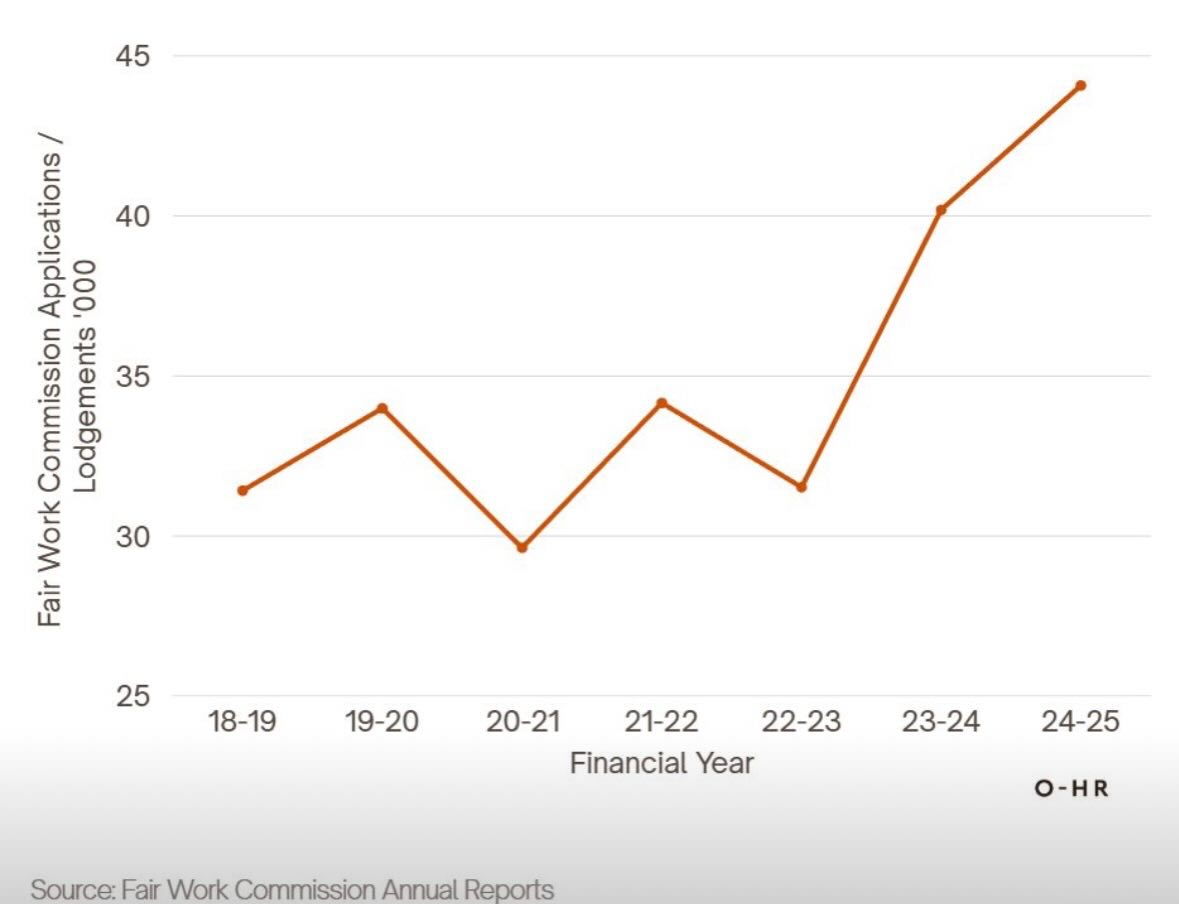
Australian HR practitioners are not imagining it. Employee relations (ER) work in Australia is increasing, but more importantly, it has become materially more complex.
Recent Fair Work Commission data shows general protections dismissal applications running around 45% higher year-on-year, with other general protections matters increasing by close to 91% , a significant increase in Fair Work Commission applications overall.
The real issue for HR leaders and practitioners is not volume alone. It is that employee relations work in Australia has fundamentally changed. Reform, stronger enforcement and overlapping legal obligations have altered how ER work unfolds, increasing judgement demands, interruption and risk in everyday practice.
Australia’s workplace relations system has always been complex. Over the past few years, it has become denser.
HR decisions increasingly sit at the intersection of:
These obligations do not arrive sequentially. They arrive simultaneously, often triggered by the same set of facts.
A performance issue can quickly become a general protections matter. A complaint can engage discrimination, WHS and procedural fairness considerations at once. Decisions that once sat comfortably within HR policy now carry regulatory and reputational consequences.
This is the backdrop against which ER work is increasing.
Is it just me, or did employee relations cases once feel simpler and more routine?
That is no longer how HR work behaves. Today, practitioners are:
HR work has become discontinuous.
This constant context-switching increases cognitive load and makes consistency harder to sustain, even for experienced practitioners operating with care and good intent.
The greatest risk in modern ER work is not capability. It is fragmentation.
When HR work is spread across inboxes, documents, multiple systems, memory.
Key elements of defensible practice become harder to maintain:
This matters because many Australian HR obligations are process-driven. It is not enough to reach a reasonable outcome. Organisations must be able to demonstrate how decisions were reached, what was considered, and when action was taken.
As work fragments, the risk of inconsistency increases, not through negligence, but through structural strain.
Rising Fair Work Commission applications are sometimes interpreted as a failure of HR practice. That conclusion is too simplistic.
What the data more accurately reflects is:
In this environment, HR is being asked to do more preventative, defensible, and human-centred work , often without systems designed to support that complexity.
For HR leaders, the implications are practical and immediate.
First, ER workload can no longer be assessed purely by case numbers. Complexity, interruption, overlapping legal regimes and the need for defensible process all materially affect capacity.
Second, increased regulatory scrutiny means organisations must assume that ER matters may later be examined by the Fair Work Commission, courts or regulators. This shifts the focus from simply resolving issues to being able to reproduce the full decision-making record.
At the same time, HR teams are carrying a significantly higher cognitive load. More frequent matters, higher volumes and greater complexity mean practitioners are holding multiple cases in mind at once, each with different facts, risks and legal tests. This materially increases the risk of human error, not through carelessness, but through sustained cognitive strain.
In this environment, leaders cannot rely solely on individual capability. They need to step up oversight by ensuring that complex ER work is supported by structures that reduce reliance on memory, improve continuity, and allow judgement to be reviewed, tested and confirmed over time.
Leaders should be actively considering how ER information is stored and structured so that, if required, they can readily demonstrate:
When this information is fragmented across emails, documents and systems, cognitive load increases and reconstructing a defensible narrative becomes difficult and risky.
Third, this environment requires organisations to rethink how HR work is supported. Investigations and ER matters are no longer isolated events. They are interconnected, prolonged and subject to review well after decisions are made.
Leaders should also be treating complaints and allegations as potential sources of psychosocial hazard identification. Allegations raised during ER matters often signal risks that extend beyond the individual case.
Psychosocial hazards emerging from complaints should be itemised on the organisation’s risk register, with clear ownership, interim controls and review points. This requires a deliberate system for capturing hazards as they arise through ER work, rather than treating investigations as closed once an individual outcome is reached.
The rise in ER activity and regulatory scrutiny does not reflect a failure of HR capability. It reflects a system under pressure.
HR practitioners are navigating more investigations, with broader legal exposure, in an environment where expectations of rigour and documentation have increased significantly. Much of this work is invisible, fragmented and carried over time.
Supporting HR practice now means:
HR has not become harder because practitioners lack skill or intent. It has become harder because the work itself has changed.
Understanding this problem clearly is the first step toward building systems and approaches that genuinely support HR practice in Australia’s current regulatory environment.