THE NOOMA WAITLIST IS NOW OPEN. Founding Members lock in 25% off. Permanently.


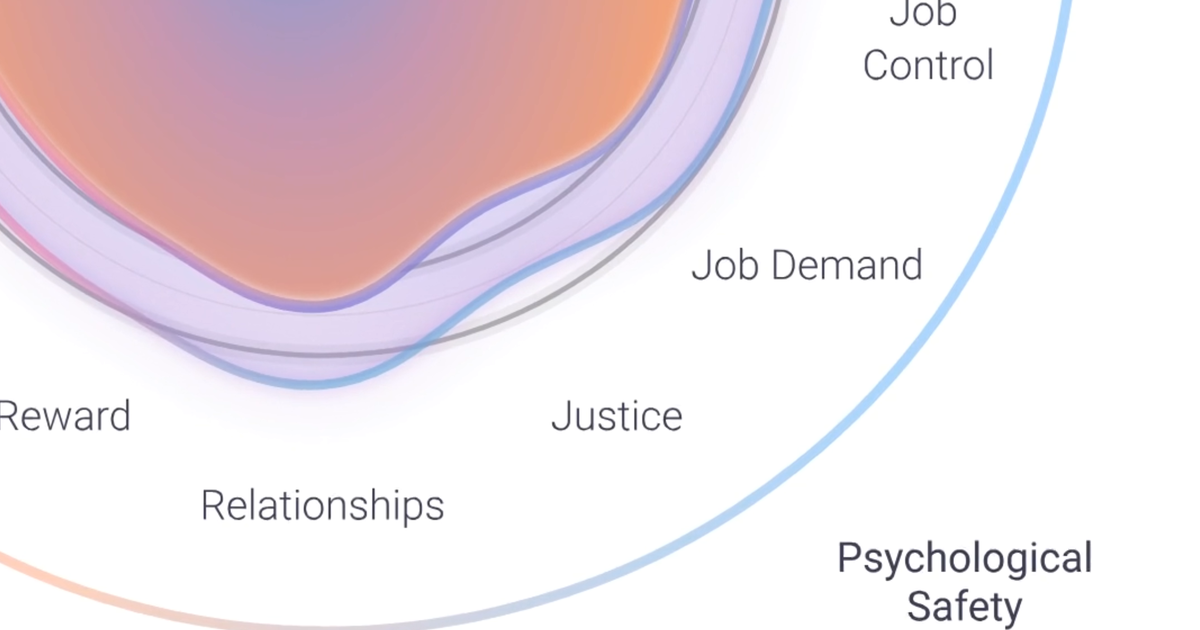
Built to support compliance with the model WHS laws as implemented in all Australian jurisdictions other than Victoria, which retains the Occupational Health and Safety Act 2004 (Vic), and with the positive duty in s 47C of the Sex Discrimination Act 1984 (Cth), inserted by the Anti-Discrimination and Human Rights Legislation Amendment (Respect at Work) Act 2022 (Cth), the Morphogram maps fourteen psychosocial indicators across two legal obligation frameworks to produce a continuously updated culture index. It integrates participation-weighted sentiment with scope-bounded behavioural activation, structured so no single event distorts the picture and built around lead rather than lag indicators of psychosocial risk. Nooma does not make culture determinations. It equips leaders to make them well.
CAPABILITY
01 No business case. No CAPEX. No communications plan.
There is no additional provider to procure, no platform to deploy across the business, and no requirement to get the entire organisation participating at once before the picture becomes meaningful. The Morphogram builds from HR workflows already running in your business, progressively and across whatever scope is active, without waiting for a single point-in-time exercise to complete.
02 Fed by the work already happening
The Morphogram learns through the daily rhythm of HR work, with crafted inputs across key workflows deepening its understanding period by period. There are no engagement surveys to run and no separate project to stand up. Practitioner intuition, quantified.
03 Sentiment and behaviour in one view
The inner ring expresses lead and lag cultural sentiment, weighted by participation and bounded so no single event can inflate the picture. It reads organisational condition rather than individual opinion. The outer ring shows that culture expressed in behaviour: how far it extends, and how often it is happening.
04 Lead indicators, by design
Australian WHS law requires a PCBU to eliminate psychosocial risks so far as is reasonably practicable, and to minimise them where elimination is not reasonably practicable. The Morphogram is built around lead indicators of psychosocial risk rather than lag measures of harm already done. It supplies the intelligence that makes identifying and assessing those risks a continuous exercise rather than a periodic one.
05 Dual obligation mapping
Fourteen psychosocial indicators, aligned to the hazards identified in Safe Work Australia's Model Code of Practice: Managing Psychosocial Hazards at Work (July 2022) and grounded in the peer-reviewed occupational health psychology literature that underpins psychosocial risk measurement in Australia, are mapped across two legal obligation arcs: psychological health and safety under Australian WHS law, and the positive duty under s 47C of the Sex Discrimination Act 1984 (Cth). Leaders see one integrated view of the cultural conditions underpinning both obligations.
06 Board ready. Always
Boards carry a governance mandate for organisational culture, and where a CHRO is an officer for WHS purposes the s 27 due diligence duty applies to them personally. The Morphogram gives you a structured, reproducible model for reporting on it: a culture index, a defined band, directional period-on-period movement, and an AI-authored narrative ready for the board pack.
07 AI-Interpreted inisghts
Each period generates a structured AI narrative summarising cultural drivers, areas of concern, active behavioural signals, and movement across indicators. Reviewed and owned by the CHRO before it goes anywhere, without analyst or consultant overhead.
CULTURE MEASURED IN THE WORK, NOT IN ADDITION TO IT
Leaders and boards get a role-restricted view of the Morphogram, updated continuously through HR practice. Condition and activation sit in one model, without a briefing, a consultant, or a survey cycle.
A LIVING MODEL OF ORGANISATIONAL CULTURE
The Morphogram connects directly to the people risk register and the Culture Risk Intervention Model. The AHRC's Guidelines set out seven Standards describing how organisations can satisfy the positive duty, and the Morphogram supports the monitoring and evaluation expectations described in Standard 7. This is the Sense layer of the Sense. Respond. Govern. framework, giving leaders the intelligence to act before escalation. Learn more about our risk management framework.
TRUST IS THE FOUNDATION
O-HR is shaped by decades of enterprise HR leadership, including the responsibility of implementing systems that safeguard large volumes of deeply sensitive data.
Nooma is built to enterprise privacy and security controls, with data encrypted in transit and at rest and SOC 2 Type II and ISO 42001 certification underway, democratising access to data protections that would otherwise be inaccessible to individual practitioners. The kind that typically requires significant resources and months of implementation to get off the ground. Through the API, Nooma users benefit from data protection aligned to enterprise agreements with the underlying model providers. Built specifically for the individual HR practitioner; you control how you work. For those who want an extra layer of separation, Nooma can be used without personal details entering the platform. Use a case reference number, export the documents, and enter personal details as you normally would. The Morphogram itself runs on de-identified data in every case.
Read about Security and Trust at O-HR. Or if you have questions, ask us.
Resources and further reading:
Work Health and Safety Act 2011 (Cth) · Model Work Health and Safety Regulations (5 December 2025) ch 3 pt 3.2 div 11 · Safe Work Australia, Model Code of Practice: Managing Psychosocial Hazards at Work (July 2022) · Sex Discrimination Act 1984 (Cth) pt IIA s 47C · Australian Human Rights Commission, Guidelines for Complying with the Positive Duty under the Sex Discrimination Act 1984 (Cth) (August 2023)