THE NOOMA WAITLIST IS NOW OPEN. Founding Members lock in 25% off. Permanently.


Further thoughts from the 2026 AICD Technology Governance Forum
Australian organisations are deploying AI at scale, and the Australian Institute of Company Directors's own research characterises our adoption as more evolutionary than revolutionary, focused on automating lower-level tasks rather than augmenting higher-order functions. At that pace and trajectory, the failure rate is not a prediction. It is already a finding.
It also has a structural cause that has nothing to do with the technology.
The AICD’s data governance research is direct about the most common causes of AI project failure: lack of strategic alignment, deploying AI without a clearly identified business problem, and failure to build organisational capability alongside the technology.
At the forum, Dr. Zivit Inbar (GAICD FCPHR) framed the investment question directly: in the organisations that have been successful in digital transformation, twenty per cent of the cost is the technology subscription. Eighty per cent is the enabling training and change management. Her question to boards followed: ‘If that’s the case, where should the board be spending their time? They should be discussing with management: what are you doing to make this real?’
Not a technology problem.
Part of why this outcome is foreseeable is in how AI has been introduced. The pattern has a precedent. When the internet arrived, organisations layered it onto existing structures. When enterprise software arrived, it was wrapped around existing processes. Each time, the technology was handed to the business, added to the stack, and what it delivered depended on the modules purchased and the investment in implementation. In my experience, the latter is consistently undercooked.
For many Australian organisations, the path of least resistance to AI-adoption has run through Microsoft Copilot, not primarily because it is the best fit for a given organisation’s work, but because it already occupies a position in the technology stack, removes the procurement and investment overhead of introducing a new vendor, and offers data residency options that satisfy governance requirements without requiring new architectural decisions. These are procurement advantages. They are not readiness conditions. Copilot is a generalist tool built for individual productivity in a Microsoft environment. Unlike deterministic software that executes a defined step reliably, generative AI is probabilistic. Without a specific use case built around it, there is no repeatable way to apply it. It is not surprising that Copilot appearing next to an open document became the modern-day paperclip: something you cancelled out of to get on with what you were doing. The organisational conditions that determine whether individual productivity gains compound into something meaningful for the business are not a feature of the tool. They sit entirely outside it.
AI is not an application. It is a change in how work is structured, how decisions are made, and the human’s role in their work. What we do is enmeshed with our identity. When that changes without the worker’s involvement in shaping it, the response is not simply adoption resistance. It is a response to lost agency, and that runs deeper than any deployment plan is designed to reach.
Organisational readiness (the capability, the trust architecture, the cultural conditions, the change design) is not the domain of the technology team. To expect this would be unfair. It is not owned by procurement or the project management office. It is organisational and human by nature.
Generative AI introduces a dimension that previous technology deployments did not encounter. It communicates in natural language. It produces output that reads as considered, sometimes conscious. For people who do not know what it is, what it is not, and how it works, those qualities are more unsettling than reassuring. GenAI can be convincing in ways that prompt real questions about its nature. An employee without a working understanding of what they are being asked to use will approach it with wariness rather than engagement. Consider the Black Cab drivers of London. They spent years memorising tens of thousands of streets, routes and landmarks across the city. Imagine the first time they saw a GPS. Generative AI arrives the same way. For many, it is an unlock: a mind-blowing experience of infinite possibilities. To others, it is a direct threat to their identity. But wariness does not mean resistance. It is the predictable result of an incomplete deployment design.
These are not peripheral risks. They are the primary causes of the failure rate being observed across industry. And there are problems with well-established professional disciplines behind them. The cost is measured at eighty per cent.
The conditions that determine whether AI works belong to a different discipline
Organisational development has a precise body of knowledge about how organisations absorb and embed change. It was once considered soft HR; however, in today’s workplace, it has very real financial consequences. It is the accumulated evidence of what happens when human systems are asked to operate differently: which conditions accelerate adoption, which conditions produce resistance, and which structural factors determine whether a change holds over time.
Strategic alignment means more than executive sponsorship and a clear business case. It means a workforce that understands why a change is happening, what it means for their work, and what the organisation is and is not asking them to do differently. It is built through deliberate engagement design.
Change readiness can be assessed: it describes the cultural and capability foundation that determines whether an organisation can absorb a change of a given scale at a given pace. There are practitioners doing great work in this space, Vanessa Elleman of Experience Evangelists is one worth watching. Most AI business cases do not include a readiness assessment. Most do not model the cost of low adoption. The professional discipline that knows how to produce and interpret that assessment has been largely absent from the investment decision.
Work and role design is the most underdeveloped dimension of AI deployment in Australian organisations. When AI changes the transactional layer of a role, someone needs to deliberately design what the human contribution becomes. What does the work look like when the repetitive elements are automated? What capabilities does that surface? What becomes the role of the human? What does meaningful work look like in that context? These are OD's core questions.
Trust architecture is the condition most consistently underestimated in AI business cases and most consistently cited in adoption failures. Employees who understand what AI is doing, why it is being used, and what it means for their security and future work are more likely to engage with it productively. It is built through the deliberate design of communication, consultation, and leadership behaviour. That design has a professional discipline and decades of empirical research behind it.
Custodianship is not a claim to technology leadership
It is stewardship of the conditions that determine whether technology serves the organisation or undermines it.
Technology leadership sits with the CIO. Commercial strategy sits with the CEO. The stewardship of the human conditions on which AI success depends (the readiness, the trust, the capability, the work design) has a professional home. What changes is the scale of the opportunity and the urgency of recognising it.
The questions about organisational readiness, workforce impact, capability requirements, and change architecture belong in the room before procurement decisions are made, not after deployment has begun. The most expensive position in any technology program is downstream of the damage.
It means AI designed into the higher-order work. OD at its best is enterprise architecture for human systems, asking what the organisation is trying to achieve, how work needs to be restructured to get there (with the people doing that work consulted as a core part of the process, not an afterthought), and what conditions need to exist for people to perform at the level the strategy demands. The organisations that succeed with AI over time are not the fastest deployers, they’re the ones who redesign their human systems deliberately, with the people in them, alongside the technology.
The eighty per cent is not a fixed number
The failure rate is not a prediction. It is already a finding.
The discipline that understands how human systems absorb change, how capability develops over time, how trust is built or destroyed, and how work needs to be redesigned when the tools change: that discipline is organisational development. It is being asked to apply itself to the most significant change challenge it has yet encountered.
Dr. Inbar's research finding from the forum is direct: ‘How much does it matter if you have AI principles? The answer is not at all. It has no impact on organisations whether they have principles or not. What has impact is whether they are embedded in a system of decision making in a meaningful way.’
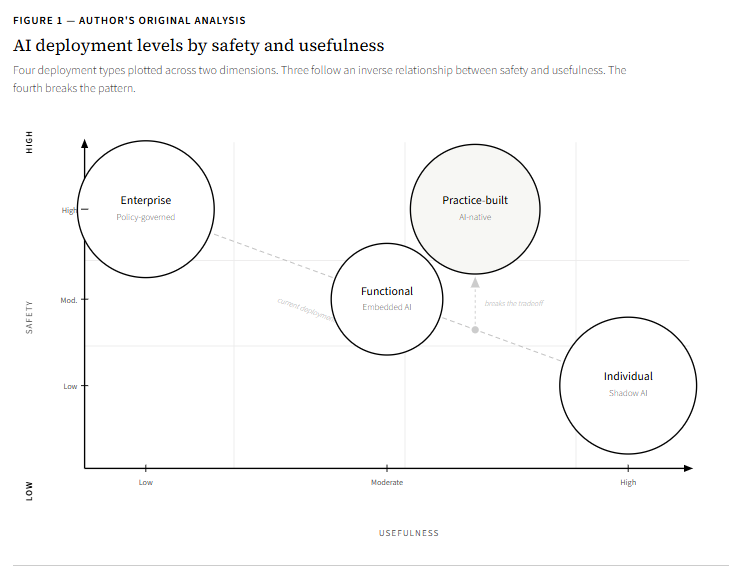
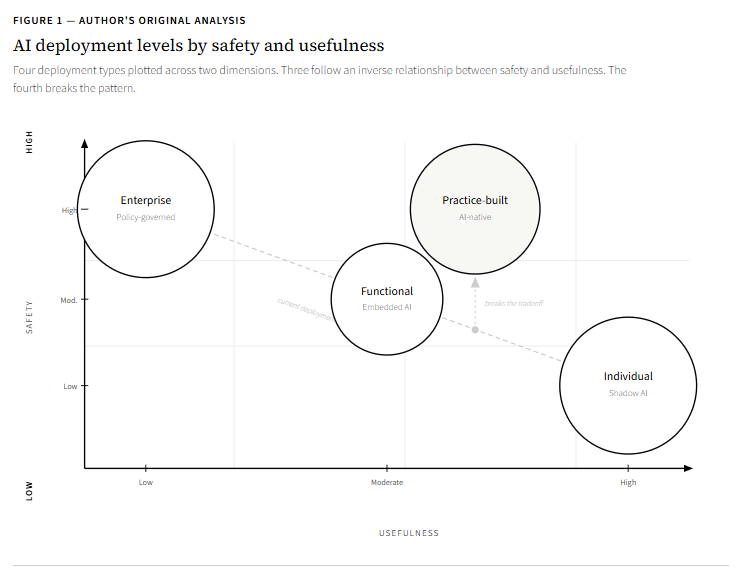
What changes the failure rate is not better governance of generalist tools. It is AI built for the specific context of the work: designed to serve a defined practice, governed at the design level rather than as a policy layer added after the fact, and deployed into organisational conditions that have been deliberately prepared. The trade-off between safety and usefulness that characterises most current AI deployment is not a fixed property of the technology, but rather how the technology has been packaged and deployed. Purpose-built, AI-native platforms for specific professional disciplines demonstrate that this trade-off can be broken: governance built into the architecture means safety and usefulness move together, not against each other.
Questions that belong in the investment decision
In organisations that have succeeded with digital transformation, eighty per cent of the total cost is training and change management. Twenty per cent is the technology subscription. That is Dr Zivit Inbar’s research finding, presented at the forum. Most AI business cases invert this proportion. That inversion is one of the conditions the failure rate reflects.
For any board evaluating an AI adoption program, these are worth putting directly to management:
These are not compliance questions – there are plenty of those. They are the conditions the evidence connects to whether a deployment succeeds or becomes part of the eighty per cent. Asking them before the investment decision, not after deployment has begun, is the difference between oversight and audit.
The eighty per cent is not inevitable. The discipline that solves it already exists.
References and further reading
1. Australian Institute of Company Directors and Melbourne Business School, Data Governance Foundations for Boards (AICD, May 2025). Available to AICD members at aicd.com.au
2. Australian Institute of Company Directors, AI Use by Directors and Boards (AICD, 2025). Available to AICD members at aicd.com.au
#HR #AIGovernance #OrganisationalDevelopment #ChangeManagement #FutureOfWork #BoardGovernance #IntelligentHR