THE NOOMA WAITLIST IS NOW OPEN. Founding Members lock in 25% off. Permanently.


Try this thought experiment. Ask a chatbot how many tokens a full-time employee generates across a working year, and it will tell you approximately 1.3 million. Ask what 1.3 million tokens costs on the most capable AI model available today, and it will tell you approximately $9.39 AUD. Striking… And honestly a little terrifying. The economic case for substitution writes itself on the back of that calculation, and across boardrooms many organisations are doing exactly that.
It is also misleading. When AI evaluates a human role, it measures outputs. What it cannot see are the other three quarters of the position: the accountability that sits with the person, the relationships they hold, the behaviours and conduct they model, and the way their presence connects the work of an organisation to its purpose. A position description is not just an administrative artefact. It describes something that cannot be tokenised.
It is measuring the token-equivalent output of a human role, not what a human in an organisation actually is. And the gap between those two things is where the real feasibility question lives, and where the current wave of AI restructuring is proceeding without the full equation.
McKinsey, Atlassian, IBM. The announcements keep coming, and the framing is consistent across all of them: human positions are being converted to AI capability. Boards approve the restructures, markets reward the announcements, and the efficiency logic is compelling. In several high-profile cases the stock price rose on the news of job cuts. Atlassian, Salesforce and IBM each framed their restructures differently, but the direction was the same: fewer humans, more AI. These AI-driven layoffs are not isolated incidents. They represent a pattern, and a philosophy. McKinsey has trimmed roughly 5,000 roles since 2023, its steepest contraction in history, while deploying approximately 12,000 internal AI agents.
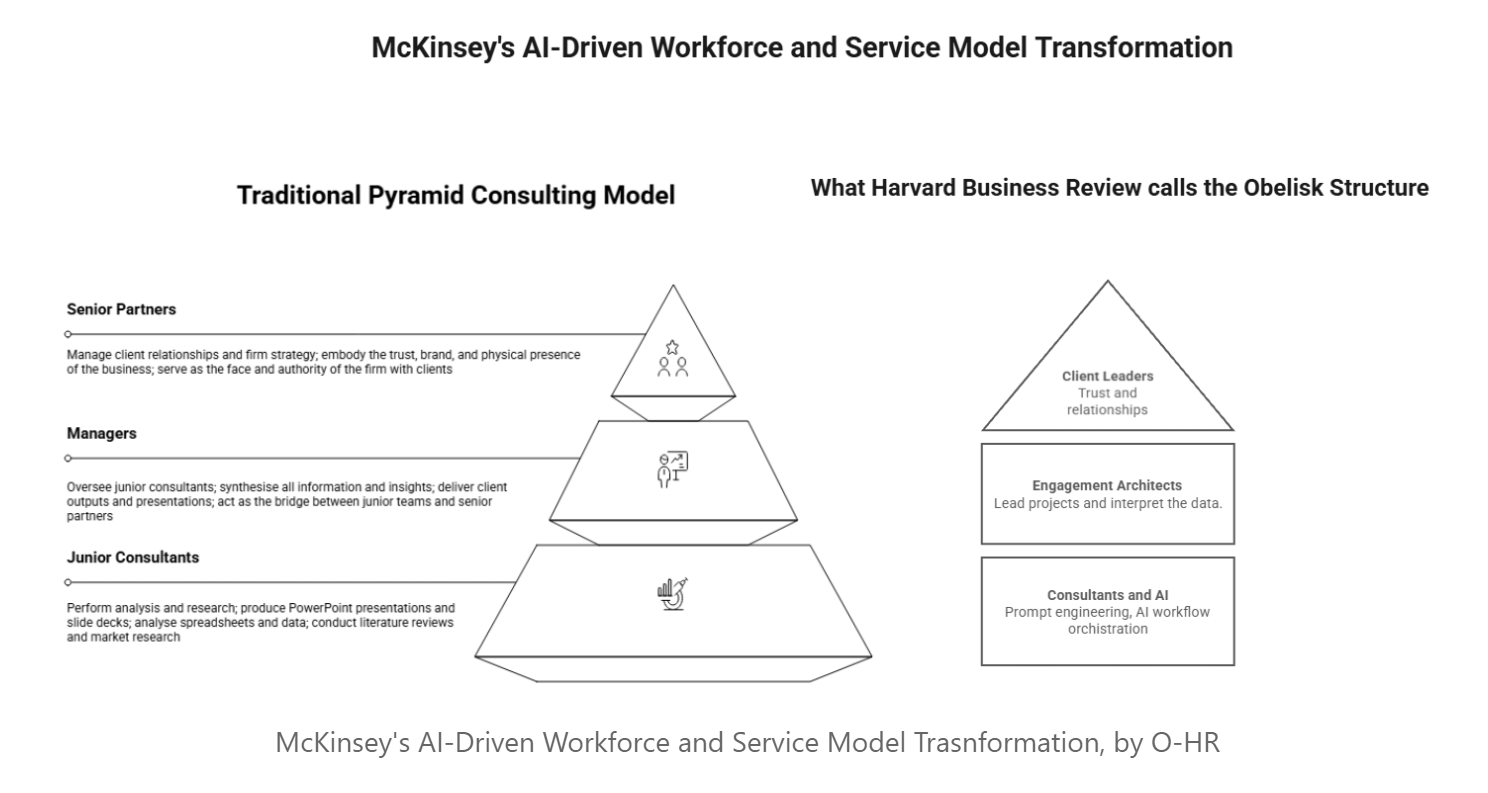
McKinsey’s AI enthusiasm is easier to understand with some context. The firm’s headcount nearly doubled in the years leading to 2022, driven by the surge in executive demand for advisory support during the pandemic. Post-COVID, that demand softened sharply and revenue stalled. The economic logic of the traditional pyramid had always rested on a straightforward arbitrage: a high-value senior creating trust and winning business delivered by an army of juniors at a much lower rate, synthesising data and producing knowledge. AI can now do much of what those junior roles required, in a fraction of the time.
What followed was a restructuring in waves: back-office roles first, then technical specialists in cloud, data engineering and software. The last round of cuts landed in late 2025. By 2026, those same roles are amongst the highest in demand, ironically driven by the very technology that displaced them. It is a useful reminder that evaluating the long-term value of a capability is harder to do when the technology reshaping it is still finding its shape.
Most restructuring decisions of this kind, looked at carefully, are replacing humans who were doing what researchers now classify as Level 1 and Level 2 work, retrieval, synthesis, drafting, and coordination, with AI operating at those same levels under human supervision. The consultants making the consequential decisions are still the consultants. What has changed is the layer of junior practitioners who were performing those tasks and, in doing so, building the professional judgment they would eventually need to make senior decisions.
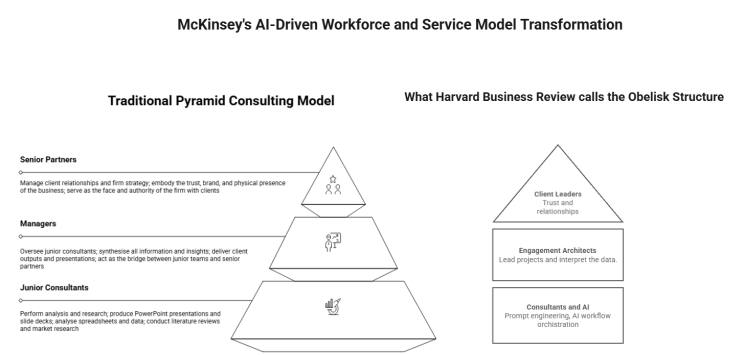
Harvard Business Review has termed what is emerging the consulting obelisk: a tall, narrow structure built around three human roles, AI facilitators, engagement architects, and client leaders, replacing the broad pyramid base with a combined tier of human consultants and AI workflow orchestration. The function is different. The accountability is different. The developmental pipeline it represents is gone.
“Just because you can outsource a decision to AI, doesn’t mean that you should.” Dr Peter Brace
That observation applies with equal force to the question of whether to outsource the early-career development pipeline that produces high-judgment practitioners. What the autonomy taxonomy being developed by researchers cannot answer is where the next generation of senior professionals comes from if you remove the conditions in which that judgment is formed.
HR practitioners have long understood the value of talent pipelining as both a performance and continuity strategy. McKinsey’s restructuring appears to reflect a conviction that the critical capabilities at the top of the obelisk can still be developed within the chain, even without the long learning curves the pyramid was designed to provide. Whether that conviction holds is one of the more consequential bets in professional services right now.
So is the McKinsey example progress or incongruence? Their Global Institute, in its landmark research on automation and the future of work found that about 30 percent of the activities in 60 percent of all occupations could be automated.
Significant, but different to the headlines. The MGI finding is about activities within roles, not roles themselves. Only around 5 percent of occupations, the same research found, could be fully automated by currently demonstrated technologies.
What is being automated is tasks. What organisations are announcing they are replacing is people.
When McKinsey deploys Lilli, its internal AI platform, to retrieve and synthesise knowledge so that consultants can spend more time on analysis and client work, it is automating tasks.
When it simultaneously removes the layer of junior analysts who were performing those tasks, it is removing people. The tasks can be transferred. The people cannot be substituted one for one, because the people were not only doing the tasks. They were also developing judgment, holding relationships, building the professional capability that eventually produces the senior thinking no AI can yet replicate.
McKinsey's own stated position captures the aspiration clearly. Its Hybrid Intelligence approach holds that when technology and people work together, we can see further and deliver lasting impact that shapes our future. That philosophy and the org chart changes happening beneath it represent the central tension of this moment: the gap between what organisations say about human and AI collaboration and the headcount decisions they are actually making.
Dr Peter Brace, CEO of PsychSafety APAC, brings an unusual combination to this conversation: decades of international consulting and project management experience working with some of Australia’s largest organisations, combined with a grounding in AI philosophy that he teaches at Swinburne University of Technology. His psychosocial safety consulting practice works with businesses undertaking workplace transformation, with a focus on creating the conditions for innovation and productivity to emerge naturally.
AI enters organisations as a headcount decision. What it is actually entering, as Dr Brace put it in a recent conversation between us, is a living human society.
To understand why the substitution logic is incomplete at a structural level, it is worth being honest about what is actually being compared when an organisation converts a human role to an AI-occupied one.
Both AI and human intelligence work on probability and pattern recognition. That is the extent of the similarity.
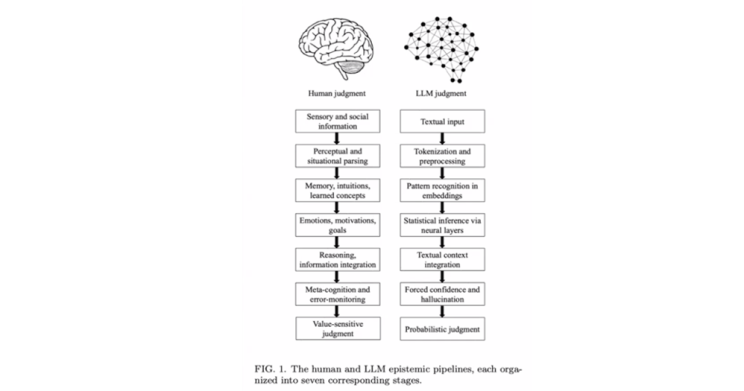
After that point, the architecture diverges entirely. Human judgment begins with sensory and social input. It runs through memory, intuition, learned concepts and emotional context before it reaches reasoning, and it is ultimately governed by values acquired through lived experience.
At the end of that pipeline sits what researchers describe as value-sensitive judgment: a conclusion shaped not only by the available information but by everything the person has experienced, lost, protected and come to understand.
AI judgment begins with text. It tokenises, recognises patterns, runs statistical inference, integrates textual context, and arrives at a probabilistic output. It does this with extraordinary speed and at a scale no human can match. But the starting point is text, and everything downstream follows from that.
Ever the academic, Peter introduced me to the model of two epistemic pipelines below, which worked nicely for my visual mind. He suggests that, while he doesn’t agree with all the assertions, it is useful because it shows how different the inputs are. One pipeline begins with the world as it is felt. The other begins with the world as it has been written down.
This is not a flaw in AI design; it’s a design characteristic. The difficulty arises when organisations treat the two pipelines as equivalent because both eventually produce an output.
“One of the most important differences, I believe, is that our thinking starts with how we’re feeling.”
Executives thinking “I do not. I am objective, applying sound decision-making frameworks to complex problems, grounded in my duty”, you may be just proving the point.
What Peter means by this, and I had to get it clarified to really wrap my mind around it, is not that emotion gets in the way of reason, but rather that feelings are prior to reason. That is a well-evidenced claim, spanning neuroscience, evolutionary biology, psychology, philosophy and even the biology of the most primitive forms of intelligence.
Tracing intelligence back to its most basic form, Peter points out that even single-celled organisms respond to stimuli. The beginning of what we call intelligence is the interpretation of a feeling: food is good, not-food is bad. Positive and negative precede everything else. From that starting point, as organisms grow in complexity, feelings accumulate meaning. The psychologist and neuroscientist Lisa Feldman Barrett, author of How Emotions Are Made and whose work Peter draws on in his teaching, has shown through decades of research that emotions are not hardwired reactions that happen to us, but are actively constructed by the brain from raw sensory input, past experience, and the body's own internal signals. We receive a feeling first. The brain then interprets it, drawing on everything we know and everything we have lived, and produces what we experience as an emotion. This is how we make meaning from the world. We do not encounter the world neutrally and then react to it emotionally. We encounter it through our senses, which produce feeling, which the brain interprets into understanding.
The implication for organisations replacing human roles with AI is not abstract. An AI system processes textual input. A human being processes the world. Those are not the same starting point, and they do not produce the same kind of intelligence.
Culture in an organisation, Peter described, is the collective expression of how a group of people is feeling. I would add behaviour as well, but that is a conversation for another day.
Culture is not the sum of tasks, not what an engagement survey captures, but how people are feeling right now, in response to everything the organisation is and is not doing around them. People at work are continuously reading the room.
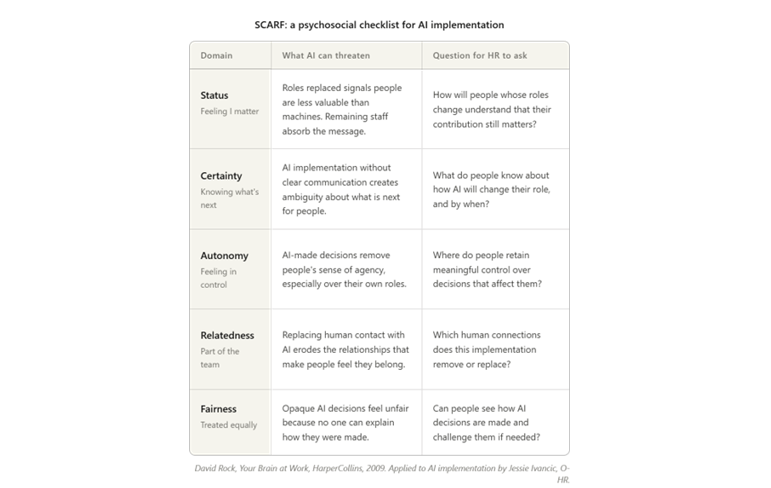
David Rock's neuroscience research on psychological safety identifies the specific domains the human brain monitors at any given moment: status, certainty, autonomy, relatedness, and fairness. These are not abstract values. They are threat-detection mechanisms that operate before any conscious reasoning begins.
Sentiment is part of the operating system.
It shapes whether people speak up, comply, withdraw, report, or stay silent. If AI changes the felt experience of work, who is present, who makes decisions, who a person can turn to when something goes wrong, it changes behaviour. Not as a side effect. As a mechanism.
Peter introduced two concepts that are worth naming here. The first is epistemia: the condition of believing you have thought something through when the thinking was actually done elsewhere.
“It can produce the semblance of thought, where we feel that we’ve thought something, we think we’ve thought it, but we haven’t actually thought it. An answer has been confidently presented to us, which we accept.”
When an organisation deploys AI to generate assessments or recommendations that are then treated as conclusions, epistemia is the risk hiding inside what looks like efficiency.
That is not an argument for avoiding AI. Human oversight is not an optional safeguard you add to an AI system. It is a structural requirement of using one.
The tool’s confidence is precisely what makes human judgment non-negotiable.
The second is aporia: the genuine state of not-knowing that drives human inquiry, growth, meaning-making and innovation. If you, like me, are up far too late typing into your terminal, you have high aporia. You know the pull.
AI does not experience it. It produces outputs. And this matters directly for the 1:1 replacement question: when you remove the humans from a system, you do not simply remove their task output. You remove aporia from the room.
The discomfort that generates genuine inquiry, the need to understand rather than simply to answer, leaves with them.
Peter was clear on this from the outset of our conversation. “AI is not just another technology.” To understand why the current moment demands more careful thinking than most restructuring decisions are applying, it helps to understand the comparison he reaches for.
He did not reach for the internet, or social media, or any of the disruptions most commonly cited in AI strategy presentations. He reached for writing. Before writing, human consciousness was entirely internal. Thought happened inside the person. Writing externalised that consciousness for the first time, enabling comparison, revision, and analysis across time and distance. There is a serious scholarly argument, most closely associated with Julian Jaynes, that writing did not simply change what humans could do but changed the structure of human consciousness itself... Let that land because it is a powerful idea. AI represents the next step in that trajectory.
Writing externalised thought. AI produces the semblance of thought, and in doing so creates the feeling that thinking has already happened.
That is a categorically different kind of change from efficiency gain, and it is why organisations restructuring around AI headcount decisions may be making choices whose full consequences are not yet visible.
The living human system framing is not a conceptual concern at the edges of the AI adoption conversation. In Australia, it has regulatory dimensions that belong at the centre of it.
Australian employers are now legally required to manage psychosocial hazards with the same rigour as physical ones. The framework is national, the penalties are real, and the data suggests three in four businesses are already exposed. How we do this, as an Australian leadership cohort, must be within these new rules.
“It doesn’t create hazards from nothing, but it amplifies hazards that are already there.”
Constant AI monitoring erodes trust and increases stress.
Role ambiguity deepens when people cannot see where a decision came from or who is accountable for it.
“People lose confidence, they’re not able to see where a decision has come from and why it’s been made, and often no one can tell why a decision has been made in a complex large language model.”
And the promise that AI would reduce workload is, in many organisations, reversing into an intensification of work as people stretch to fill the additional capacity AI creates.
Workplace psychological safety, Dr Brace argued, is the appropriate control mechanism for all of this. Not just in the cultural sense, but as a measurable, legally relevant organisational control.
Not a cultural aspiration, not a wellness programme, but an actual organisational control: the conditions under which people will speak up about emerging hazards before they become claims.
For CEOs reading this, the stakes extend well beyond workforce welfare. Mental health compensation claims in Australia have increased 161 percent over the past decade and now account for 12 percent of all serious workers compensation claims. The median time lost from these claims is 35.7 working weeks, almost five times the median across all other injuries and diseases, with median compensation of $67,400 before operational impact, recruitment, replacement and training costs are factored in. The legal and financial exposure is not theoretical.
David Rock's SCARF framework maps the five domains that either support or erode psychological safety: status, certainty, autonomy, relatedness, and fairness.
Every one of them is directly implicated in AI implementation decisions, and every one of them represents a question that should be in the room when those decisions are made.
HR practice sits in the space where this tension is most acute, and where the professional judgment at stake is least substitutable.
AI can do a great deal in HR practice.
“When you understand the domain, and you use AI as a tool to help you think more deeply about something, it can work very well.”
That condition, understanding the domain, is the critical one. It requires a human who knows what is at stake, can recognise when the pattern AI has identified is missing the context that changes everything, and who holds the accountability for the outcome. That role occupied by a person is not a cost to be optimised, it is a control mechanism that allows organisations to realise the benefit of AI.
A governing principle of O-HR’s view on GenAI adoption in HR is human in control, not human in the loop. The distinction matters more than it might first appear. Human in the loop describes a process where a human is nominally present at a checkpoint. Human in control describes a practitioner who is actively governing the work AI is doing, who understands what the tool can and cannot see, and whose judgment drives the outcome.
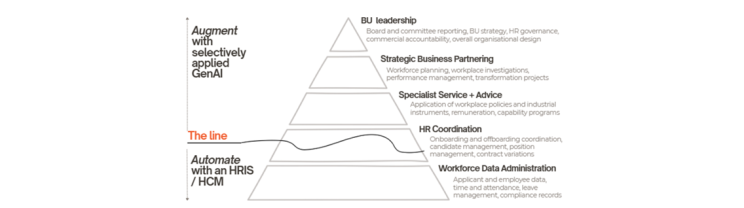
The practical expression of that principle is the automation-augmentation line.
It is important to understand that this is a hierarchy of tasks, not of jobs or positions. Every role contains tasks that sit at different points along the line.
The role titles used as reference points are indicative of where certain tasks tend to cluster, not a statement that entire positions are automated or augmented whole. This is fundamental to how O-HR approaches AI integration: we evaluate by the task, not the position.
Work that sits below the line, where judgment requirements are minimal and the stakes of error are low, is a genuine candidate for automation. Work that sits above it requires human expertise, and AI’s role there is to augment rather than replace: to reduce mental load, surface information, and prompt deeper thinking, while the practitioner retains the decision.
Knowing where the line sits is not a universal answer that a framework can provide. It is a professional judgment about the specific decisions, processes, and relationships that constitute each organisation’s psychosocial environment.
“AI is still working within human meaning and how we make meaning in the workplace. If we forget that, psychosocial hazards are increased. If we design for it, psychosocial hazards could actually be managed more effectively.”
There is a commercial reality worth naming here too, one that rarely enters the boardroom conversation alongside the headcount savings. The frontier AI model investment is enormous and the revenue is not yet commensurate. OpenAI, Anthropic, Google and Microsoft are collectively deploying capital at a scale the commercial returns have not yet justified. The economics of AI at the frontier are still being determined. Organisations that are restructuring now on the basis of a cost calculation are making long-term structural decisions against a financial model that has not yet proven itself.
None of that is an argument against AI adoption. We will all, in time, be operating in agentic organisations where AI is embedded across most functions and most processes. That transition is not speculative. It is underway. The question is not whether, but how, and what we choose to value and protect as we design our way into it.
So while the napkin maths might look incredible, consider what the equation is missing.
The economics are uncertain. Frontier model investments are far exceeding their revenue, and cost architecture will inevitably change.
The headlines declaring AI has stepped into human jobs are doing a better job of capturing attention than they are of honouring the full complexity of what is actually happening. Much of what human beings carry in organisations, the accountability, the relationships, the meaning-making, the capacity to hold a room together when something goes wrong, cannot be held by a machine. Not because the machine lacks the processing power, but because these things are not processing problems. They are human ones.
Organisations are human ecosystems, and the move toward AI adoption will only realise its promise of innovation and performance if it takes the wellbeing of that ecosystem seriously.
How we build agentic organisations, and what we decide is worth protecting as we do, is not a technology question. It is a human one.
Special thanks to Dr Peter Brace
Peter, thank you. This conversation has the kind of depth that only genuine academic rigour, combined with experience working inside real organisations, can produce. I am grateful for your time, your thinking, and your generosity in sharing both.
Dr Peter Brace PhD is the CEO and founder of PsychSafety APAC, a specialist psychosocial safety consulting practice working with Australian and Asia-Pacific organisations undertaking workplace transformation. He has broad and deep experience in international consulting and project management, having supported some of Australia’s largest organisations with their strategic direction, as well as working across the Asia-Pacific region with prominent multinational organisations including IBM and BMC. He teaches AI philosophy at Swinburne University of Technology, making him one of a rare group of practitioners who brings both philosophical grounding and psychosocial expertise to the question of how AI lands inside human systems.
About Nooma
Nooma is O-HR's AI-enabled Australian HR platform, currently in its final stages of development before release. Our equation for the future is human + AI. Not - human + AI. Our vision is a future where human-led HR service delivery is strengthened by safe, intelligent systems, elevating the quality and impact of HR in the human-machine era. If that is the future you are hoping for too, join the waitlist.
Follow for more on human-led HR leadership in the AI era.
Further reading and references
Duncan, D., Anderson, T. and Saviano, J., “AI Is Changing the Structure of Consulting Firms,” Harvard Business Review, September 2025. hbr.org/2025/09/ai-is-changing-the-structure-of-consulting-firms
Gunawardena, J., Dexter, J. et al., "Can a single cell 'change its mind'?" Harvard Medical School / Current Biology, December 2019. Video available at: vimeo.com/377382811
McKinsey Global Institute, “A Future That Works: Automation, Employment and Productivity,” January 2017. mckinsey.com
Quattrociochi, W., Capraro, V. and Perc, M., “Epistemological fault lines between human and artificial intelligence,” 2025 working paper (forthcoming).
Barrett, L.F., How Emotions Are Made: The Secret Life of the Brain, Houghton Mifflin Harcourt, 2017. Rock, D., Your Brain at Work, HarperCollins, 2009.
Safe Work Australia, Key Work Health and Safety Statistics Australia 2025, October 2025. data.safeworkaustralia.gov.au
#HRLeadership #CHRO #HumanLedHR #AIinHR #HRPractice #AustralianHR #PeopleStrategy #PsychosocialSafety #PositiveDuty #WorkplaceMentalHealth #PsychologicalSafety #ArtificialIntelligence #AIEthics #AgenticAI #FutureOfWork #AIAdoption #HumanInTheLoop #Leadership #CEOs #BusinessStrategy #OrganisationalDesign #Governance