THE NOOMA WAITLIST IS NOW OPEN. Founding Members lock in 25% off. Permanently.


One of the most important empirical studies on generative AI in the workplace and AI productivity to date is the Harvard Business School and Boston Consulting Group (BCG) working paper Navigating the Jagged Technological Frontier. It examined real consultants doing real work using GPT-4 in 2023, shortly after the model’s release.
The headline results are often summarised as productivity gains. Faster task completion. Higher output quality. More work done.
Yes, the study found work was completed around 25 percent faster. But it also found that work was significantly higher quality, with output quality improving by more than 40 percent. Outputs were judged to be materially higher quality, demonstrating improved reasoning, structure, and decision-making.
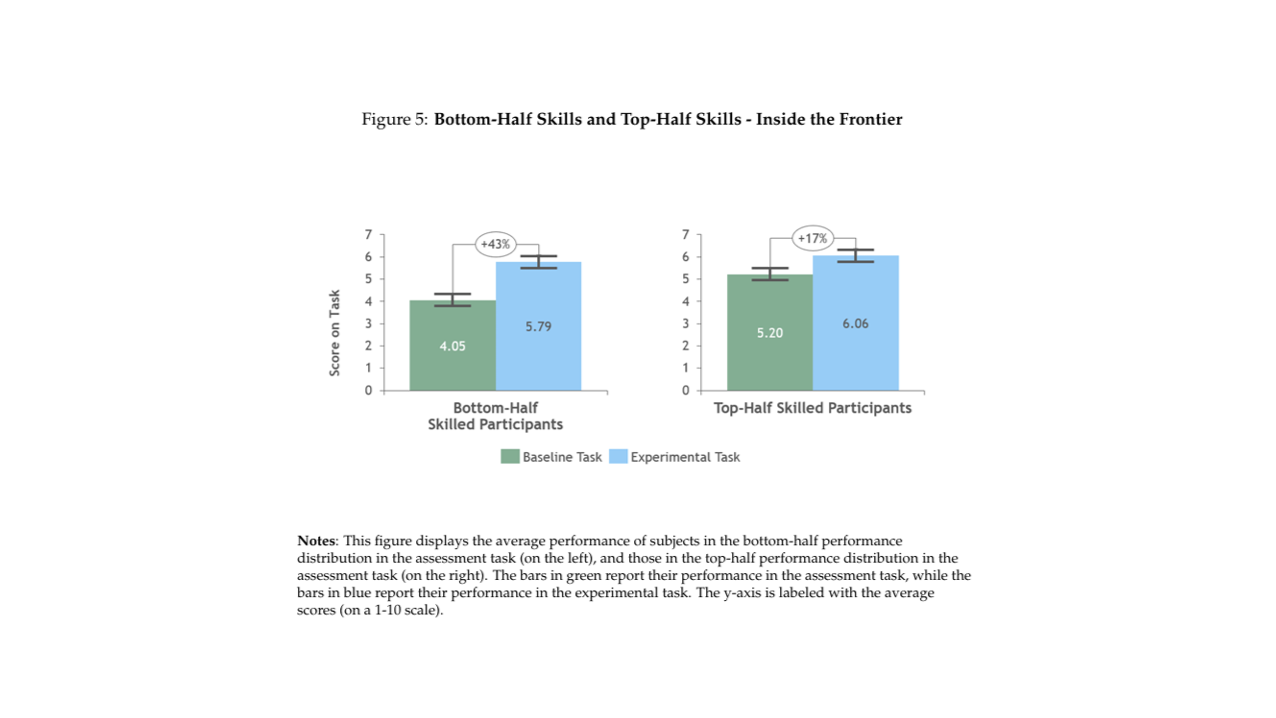
The paper then surfaces a less appreciated learning. When the results are analysed by skill level, a deeper story emerges.
Higher-skilled participants improved by 17 percent.
Lower-skilled participants improved their performance by 43 percent.
AI raises the floor faster than it raises the ceiling.
That is not a marginal efficiency effect. It is a structural capability shift.
Generative AI does not simply help experts do what they already do a bit faster. It enables people with less experience or narrower skill sets to perform work that previously required significantly more expertise. In other words, capability is no longer located solely in the individual. It is partially embedded in the AI-enabled system they work within.
For HR and people leaders, this should be uncomfortable in the best possible way.
If the performance floor rises faster than the ceiling, traditional assumptions about role design, capability frameworks, and high performer dependency start to break down. Access to complex work can broaden, teams become less dependent on a small number of experts, and capability can be distributed more widely across the organisation.
But this does not happen by accident.
The same study introduces the concept of a jagged technological frontier. Some tasks sit well within AI’s current capability and benefit enormously from augmentation. Others do not. When AI is used outside its effective boundary, outcomes can degrade rather than improve.
That means AI-driven capability expansion depends on design. Thoughtful task selection. Clear expectations around judgement and validation. And deliberate design that recognises how work is actually getting done.
This includes decisions about which tasks are appropriate for AI support, where human judgement must remain central, and how validation and accountability are built into everyday workflows, not bolted on afterwards.
This is not about replacing people. It is about productivity gains and capability growth, enabling organisations to focus human effort on higher order work that delivers greater impact.
The leaders that get this right will not simply adopt AI.
They will deliberately define the jagged line across their organisation, separating work that should be augmented by AI from work that must remain human, and in doing so unlock new levels of capability in their people.
Reference Dell'Acqua, F., McFowland III, E., Mollick, E. R., Lifshitz-Assaf, H., Kellogg, K., Rajendran, S., Krayer, L., Candelon, F., & Lakhani, K. R. (2023). Navigating the Jagged Technological Frontier: Field Experimental Evidence of the Effects of Artificial Intelligence on Knowledge Worker Productivity and Quality. Harvard Business School Working Paper No. 24-013. https://www.hbs.edu/faculty/Pages/item.aspx?num=64700
Jessie Ivancic is a Chief Human Resources Officer and founder of O-HR. She helps organisations design AI-enabled and human capability, not just adopt tools. If you are interested in what this looks like in practice, join the waitlist.